
What Creosote Removal Actually Involves and What Deer Park Homeowners Usually Get Wrong
Most homeowners in Deer Park and the surrounding Ronkonkoma area burn wood all winter without giving much thought to what’s accumulating inside their flue. That’s not a criticism. It’s just how it goes when a fireplace works the way it’s supposed to. But creosote doesn’t announce itself, and the misconceptions around how it’s removed, how serious it is, and what a real cleaning costs are responsible for a lot of preventable chimney fires every year across Suffolk County. Here’s what the job actually looks like, and where the common thinking goes wrong.
Creosote Is Not Just Soot
One of the most persistent misunderstandings is that creosote and soot are basically the same thing. They’re not. Soot is loose, powdery, and relatively easy to brush away. Creosote is a byproduct of incomplete combustion, wood smoke that cools and condenses on the liner before it exits the flue. The result is a sticky, tar-like compound that builds up in layers over time and becomes progressively harder to remove.
The Chimney Safety Institute of America classifies creosote in three stages. First-degree buildup is the dusty, flaky material most people picture. Second-degree is harder, more concentrated, and tar-like. Third-degree is the worst, a thick, glazed coating that can actually fuel a chimney fire hot enough to crack terra cotta liner tiles or warp a stainless steel flue insert.
In parts of Deer Park where older homes still have original clay tile liners, third-degree creosote is a genuine structural risk. Standard brushing cannot remove second- or third-degree buildup. That’s an important distinction, and it’s one reason a homeowner who paid for a “chimney sweep” two years ago might still have a serious hazard inside their flue.
The Chimney Doesn’t Have to Be Visibly Dirty to Be Dangerous
A lot of people assume that if their fireplace draws well and there’s no visible staining, the chimney is fine. This isn’t how creosote works. It accumulates on the interior walls of the flue, not in places you can see from the firebox or from the roofline.
NFPA 211, the standard that governs chimney inspection and cleaning, recommends a Level 1 inspection at minimum once per year. That’s not because chimneys always need work, but because buildup can reach a hazardous level before any functional symptom appears.
A chimney fire can reach temperatures above 2,000 degrees Fahrenheit. Many of them go undetected entirely because they burn inside the flue rather than producing visible flames. Suffolk County fire departments respond to chimney fires regularly across Brentwood, Bay Shore, and Central Islip, and the homes involved almost always show signs of heavy creosote that had gone unchecked.
What a Real Creosote Removal Job Looks Like
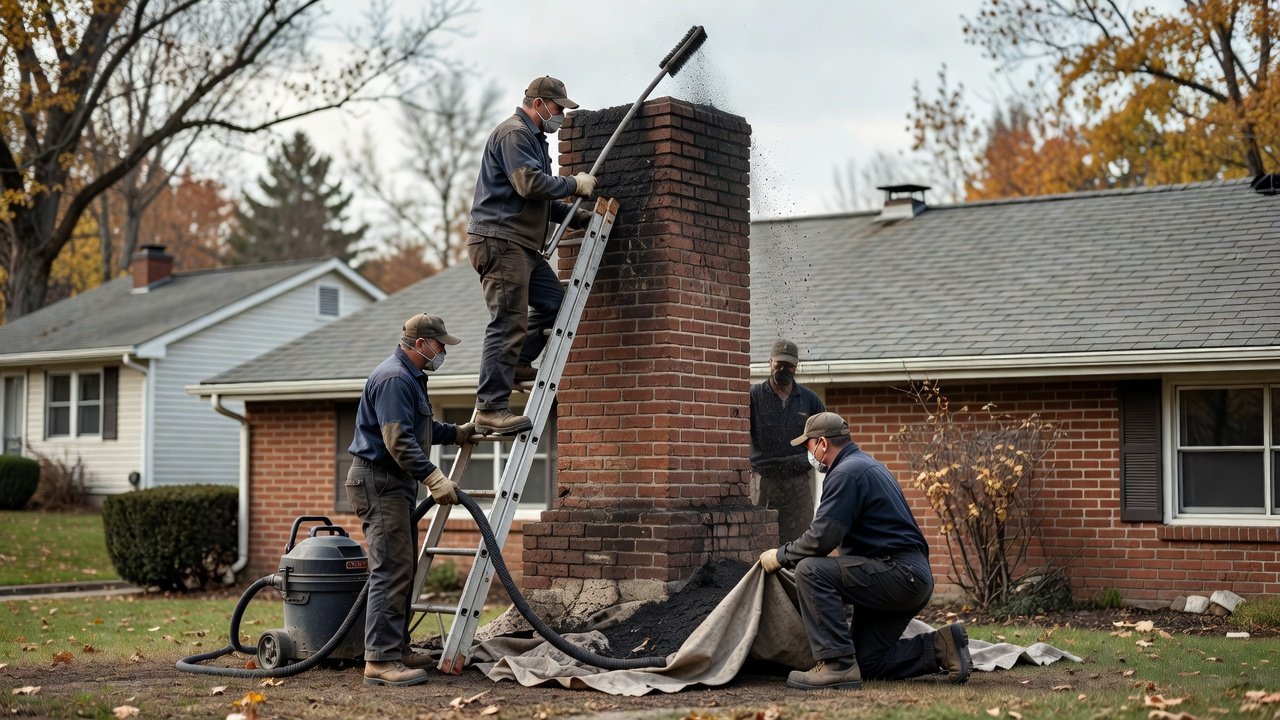
This is where honest expectations matter most. A Level 1 chimney cleaning for a home in Deer Park with a standard 30-foot flue and moderate first-degree buildup takes roughly 45 minutes to an hour. A technician sets up drop cloths in front of the firebox, seals the opening to control dust, then works brushes from above, either from the rooftop or through the firebox opening, to clear the flue walls, smoke shelf, and firebox. The debris is vacuumed out with an industrial HEPA unit.
Second-degree buildup changes the job significantly. Chemical treatment sprays are applied during a first visit, allowed to penetrate the hardened creosote over a few weeks, and then the material is removed on a second appointment. The cost increases accordingly, typically $250 to $500 for a standard cleaning in the Ronkonkoma area, rising to $400 to $800 or more when chemical treatments are involved.
Third-degree buildup sometimes requires full liner replacement, which runs $1,500 to $3,500 depending on flue length and liner type. Any quote significantly below that range for a home in Deer Park should raise a question: is the technician actually inspecting for creosote degree, or just running a brush through and calling it done?
Annual Cleaning Is Not Just for Heavy Burners
There’s a belief that occasional fireplace users, people who light a fire a handful of times each winter, don’t really need annual service. The CSIA’s guidance doesn’t work that way.
Even limited use produces creosote. Wood that isn’t fully seasoned, slow-smoldering fires, and restricted air supply all accelerate buildup regardless of how often the fireplace is used. A few slow, smoky fires can deposit more creosote than a full season of hot, well-ventilated burns.
Ronkonkoma-area homes with gas fireplaces aren’t off the hook either. Gas logs produce less creosote, but they still require annual inspection for liner integrity, blockages, and carbon monoxide risks, all governed by the same NFPA 211 standards.
DIY Creosote Logs Don’t Replace Professional Removal
Creosote-sweeping logs are sold at hardware stores across Long Island, and they work partially. They use chemical additives that can loosen first-degree creosote and make subsequent brushing more effective. What they don’t do is remove the material from the flue.
A homeowner who burns one of these logs and considers the job finished has loosened debris that’s now sitting on the smoke shelf waiting to ignite. The EPA and CSIA both treat these products as a supplement to professional cleaning, not a substitute for it.
In a home where no professional service has been done in several years, burning a sweeping log can actually create a short-term fire risk by breaking off large chunks of loosened creosote inside a flue that isn’t being actively monitored.
One Cleaning Does Not Cover the Whole System
Finally, many homeowners think a chimney sweep addresses the entire system. A cleaning addresses the flue. A complete service also includes inspection of the firebox, the damper, the smoke chamber, the crown, the flashing, and, depending on the inspection level, the liner itself.
NFPA 211 defines three inspection levels, and Level 2 is required any time a home changes ownership, after a chimney fire, or when a significant change is made to the appliance. Homes being sold in Deer Park and across Ronkonkoma regularly turn up undisclosed liner damage or deteriorated mortar joints that a surface cleaning would never catch.
That’s not a technicality. It’s the difference between a safe heating season and a house fire.
Schedule Your Chimney Inspection
If you’re in Deer Park, Ronkonkoma, or anywhere in Suffolk County and haven’t had your flue inspected this season, Ridgewood Chimney offers free chimney inspections with honest, written findings and no upsell pressure.
Call or request an appointment online to get on the schedule before peak burning season.
Related from Deer Park Chimney NY: Creosote Removal in Deer Park, NY — Before the Cold Season Traps the D · Chimney Flue Cleaning in Deer Park, NY