
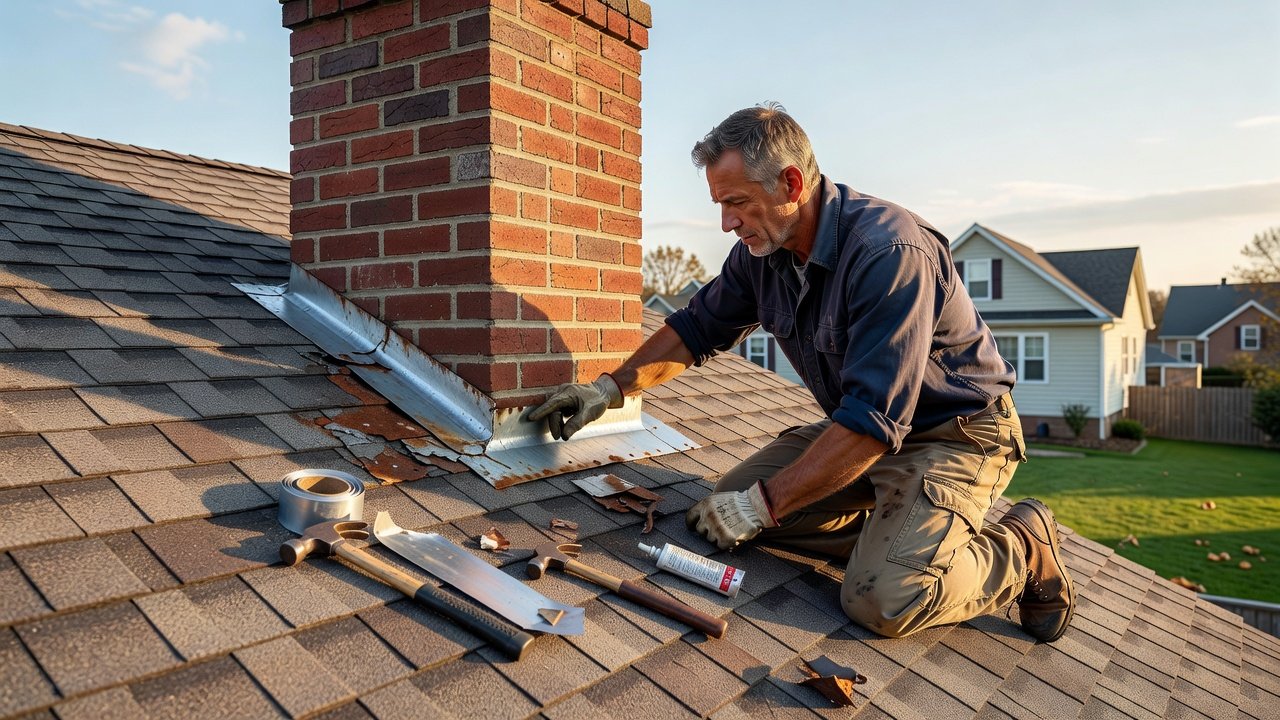
Chimney Flashing Repair in Deer Park, NY: What’s Actually Wrong and What It Costs to Fix It
Water stains near a fireplace can sometimes be traced to the area where the chimney meets the roof. Chimney flashing is designed to help prevent water from entering that vulnerable roof-to-chimney intersection.
When flashing is damaged, improperly installed, or no longer sealed correctly, water can enter around the chimney and eventually affect roofing materials, insulation, framing, ceilings, or walls. CSIA identifies flashing as an important part of protecting the home from rainwater entering around the chimney.
For homeowners in Deer Park, Babylon, North Babylon, and nearby Suffolk County communities, understanding the type of flashing problem is the first step toward determining the appropriate repair.
Deteriorated Sealant Around the Flashing
Symptoms: Water appears after rain. Staining may develop around the chimney or in the attic.
Sealant can deteriorate over time because of weather exposure and movement between different building materials. However, caulk or roofing cement should not automatically be treated as the entire flashing system.
A proper evaluation should determine whether the underlying base flashing, step flashing, and counter-flashing are still functional.
If the metal is intact and the problem is limited to an appropriate sealant joint, localized maintenance may be possible. If the flashing itself is corroded, loose, incorrectly installed, or missing, replacing the sealant alone will not solve the underlying problem.
The appropriate repair material depends on the flashing material, masonry, roof system, and manufacturer’s or product requirements.
Counter-Flashing Has Pulled Away From the Chimney
Symptoms: Flashing appears loose against the masonry. Water may enter around the sides of the chimney.
Counter-flashing works with the base and step flashing to protect the chimney-to-roof intersection. On masonry chimneys, counter-flashing may be integrated into mortar joints or installed using another appropriate method.
When mortar deteriorates or the flashing becomes loose, water can find a path behind the flashing.
A technician should evaluate the masonry and flashing together. If the mortar joint needs repair, the counter-flashing may need to be reset as part of the work.
There is no single universal repair depth or fastening method that should be applied to every chimney. The construction of the existing chimney and the applicable roofing and masonry requirements determine the appropriate repair.
Step Flashing Was Installed Incorrectly
Symptoms: Water appears near one side of the chimney or becomes noticeable after rain. The attic may show localized moisture around the chimney intersection.
Step flashing consists of individual pieces of metal integrated with the roofing material along the sides of a chimney. The pieces work together with the shingles and counter-flashing to direct water away from the roof-to-chimney joint.
If the flashing was installed incorrectly or damaged during a roof replacement, water may bypass the intended drainage path.
Proper diagnosis can require examining the roofing materials adjacent to the chimney. In some cases, shingles need to be carefully removed or lifted so the flashing arrangement can be evaluated.
The repair may involve replacing some or all of the step flashing and then restoring the surrounding roofing materials. Because flashing and roofing are closely connected, homeowners should confirm whether the contractor handles both portions of the work.
Chimney Crickets and Saddles
A cricket or saddle can help divert water around the uphill side of a chimney.
New York’s Residential Code contains specific requirements for chimney crickets. The current code requires crickets where the dimension of the chimney parallel to the ridgeline is greater than 30 inches and the chimney does not intersect the ridgeline. The cricket must also be flashed and counter-flashed at the chimney intersection.
This is more precise than simply saying that every chimney wider than 30 inches needs a cricket.
If an existing cricket is damaged, the repair may involve rebuilding the structure, replacing its covering, repairing the flashing, or addressing more than one component.
A professional should evaluate the chimney and roof configuration before recommending a repair.
Corrosion and Incompatible Materials
Flashing can deteriorate through corrosion, physical damage, poor installation, or prolonged exposure to moisture.
Problems can become more complicated when incompatible metals are used together. The appropriate material combination depends on the existing roof, flashing, fasteners, masonry, and other components.
Visible corrosion, pitting, holes, loose sections, or staining around the flashing should be evaluated rather than covered with another layer of sealant.
Replacing damaged flashing with compatible materials can provide a more durable solution than repeatedly sealing the same deteriorated area.
Homeowners should also be cautious about assuming that copper, galvanized steel, or another material is automatically the correct choice. Material selection should account for the entire roof and chimney assembly.
What Determines Chimney Flashing Repair Cost?
There is no reliable single price for chimney flashing repair in Deer Park or Suffolk County.
Several factors can affect the final cost:
- Chimney size and configuration
- Roof pitch and accessibility
- Type and condition of the existing flashing
- Amount of roofing material that must be removed
- Condition of the surrounding masonry
- Whether a cricket or saddle needs repair
- Flashing material
- Extent of water damage
- Whether roofing and chimney work must be coordinated
A small localized repair can be very different from a complete chimney reflash.
For that reason, homeowners should be cautious about contractors who provide a fixed price without first examining the chimney and the surrounding roof.
Why Water Damage Can Become More Expensive
Flashing problems should not be ignored simply because the leak is small.
Water can travel through building assemblies before appearing inside the home. A stain on a ceiling does not necessarily identify the exact point where water entered.
If moisture continues to enter around a chimney, it can affect roofing materials and other building components. The longer the underlying leak continues, the more extensive the resulting repair may become.
That does not mean every flashing leak will lead to major structural damage. The extent depends on how much water is entering, how long the problem has existed, and which materials have been affected.
How a Professional Diagnoses Chimney Flashing
A proper evaluation starts with the visible chimney and roof conditions.
The technician should examine the flashing, counter-flashing, surrounding masonry, roof covering, chimney crown, and other accessible areas that could contribute to water intrusion.
CSIA’s Level 1 inspection guidance describes Level 1 as the appropriate inspection level for routine chimney inspections when the system continues to be used without significant changes. The inspection covers readily accessible portions of the appliance and chimney.
The appropriate inspection level can change when circumstances change. A more extensive evaluation may be appropriate when the chimney or appliance has undergone a significant change or when the situation requires examination beyond readily accessible areas.
The goal is to identify the actual source of the problem rather than simply applying more sealant to the most visible area.
Choosing a Chimney Flashing Contractor in Deer Park
If you see water staining near a chimney, visible flashing damage, or signs of deterioration around the roof-to-chimney intersection, have the area evaluated before the problem becomes more extensive.
Ask the contractor to explain whether the problem involves sealant, step flashing, counter-flashing, the chimney crown, masonry, the roof covering, or several components.
It is also useful to ask whether the proposed repair is localized or whether the existing flashing system needs to be replaced.
Annual chimney inspections are recommended by CSIA, with maintenance and repairs performed when necessary.
A proper flashing repair should address the path water is taking rather than simply covering the visible symptom. Understanding what failed and why can help homeowners make a more informed decision about the repair.
Related from Deer Park Chimney NY: Chimney Repair in Deer Park — What It Costs, What It Fixes, and Who Do · Professional Chimney Repair in Deer Park, NY · Chimney Repair in Deer Park, NY