
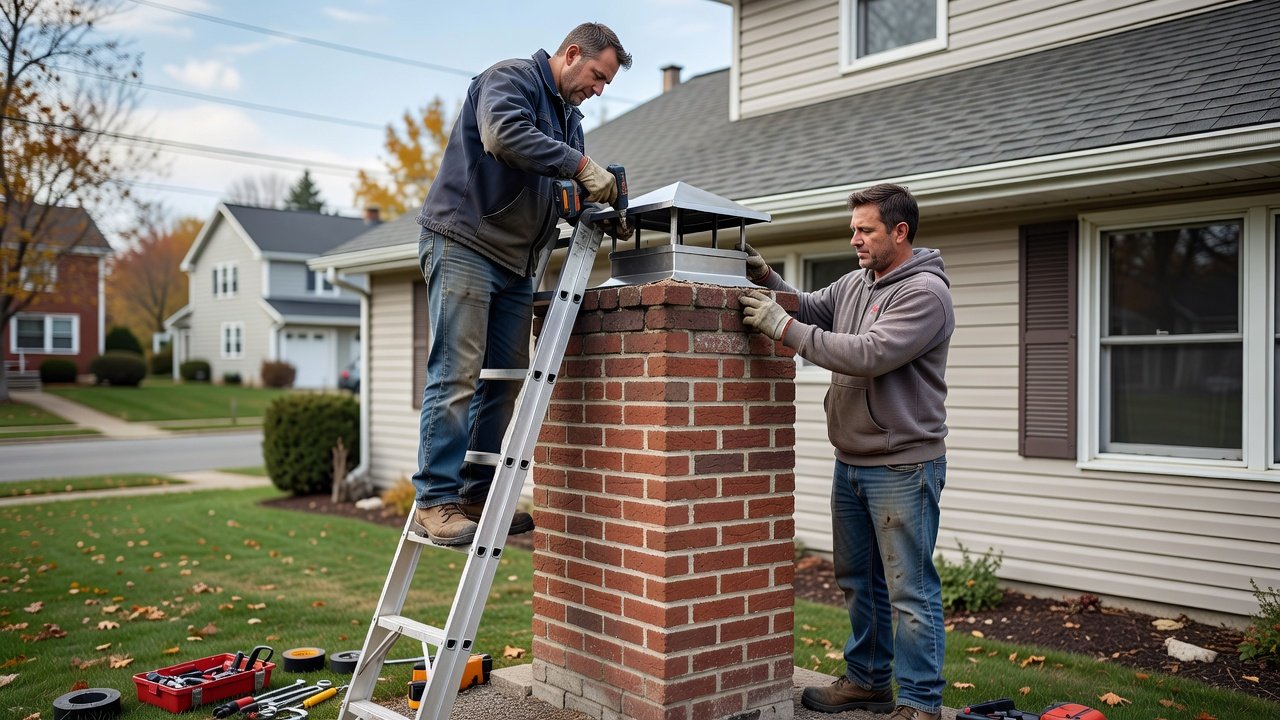
Chimney Cap Installation in Lake Grove: What You Can Do Yourself and When to Call a Pro
Most chimney problems don’t announce themselves until something goes wrong inside the house. Water stains on the ceiling near the flue, animals scratching around in the firebox, or a musty smell rolling out of the fireplace on a cold October morning can often be traced back to one missing or failed component: the chimney cap.
For homeowners in Lake Grove and across Suffolk County, getting a cap installed or replaced before winter is one of the few chimney tasks where timing genuinely changes the cost. This post gives you a straight answer on what you can handle yourself and what’s worth calling a professional for, including the real reasons behind that decision.
Why the Chimney Cap Gets Skipped and Why That’s a Problem
A chimney cap sits at the top of the flue and does several things at once. It keeps rain and snow out of the liner, blocks birds and squirrels from nesting inside, and stops wind-driven downdrafts that push smoke back into the living room.
Without one, the masonry at the top of the chimney, called the crown, takes direct water exposure every time it rains. In Lake Grove, where nor’easters and coastal moisture hit hard between November and March, an uncapped flue can absorb enough water over a single winter to crack the liner or spall the brickwork around the top courses.
NFPA 211, the standard that governs chimney construction and inspection in the United States, identifies chimney caps as a required component on listed systems. The Chimney Safety Institute of America (CSIA) goes further, noting that water is the leading cause of chimney deterioration.
The cost of ignoring this is concrete. A cracked terra cotta liner section in Lake Grove typically runs $200 to $400 per section to repair, while a full liner replacement using a stainless steel flexible liner can run $2,500 to $4,500 depending on flue height and diameter. A quality stainless steel chimney cap costs $50 to $200 in materials. The math isn’t subtle.
What a Homeowner Can Safely Handle
Not every chimney task requires a licensed professional, and pretending otherwise doesn’t serve anyone. Here’s where a capable homeowner can do the work themselves:
Removing an old, slip-fit cap: If it simply lifts off the crown with no mortar or screws into the liner, removal can be manageable.
Cleaning visible debris: You can brush debris from the top of an accessible cap.
Replacing a basic single-flue cap: This may be possible on a one-story or low-slope roof where you can safely and comfortably access the chimney top with a ladder.
Checking the cap from the ground: Use binoculars to see whether the mesh is intact or whether the cap has shifted.
The honest caveat is the roof. If your chimney extends significantly above the roofline, the roof has a steep pitch, or you’re working on a two-story home where a fall could be serious, the access problem alone makes this a professional job. The concern isn’t necessarily the cap installation itself. It’s safely reaching the chimney.
When to Call a Professional and Why
There are situations where DIY isn’t just inadvisable. This is where things can go wrong in ways that cost real money to fix.
Call a professional when the cap needs to be anchored into the flue tile or liner. This requires knowing the exact liner dimensions and using appropriate fasteners that won’t crack the tile.
Call a professional when the chimney crown is damaged. A new cap installed over a cracked or eroded crown can still allow water to enter the system.
Call a professional for multi-flue chimneys. These systems may require a custom cover rather than a stock cap.
Call a professional when there is water staining inside the home. Water entering the firebox or appearing near the chimney may indicate existing liner, crown, or flashing damage. The source should be identified before the opening is simply covered.
Call a professional for factory-built fireplaces. The cap must match the specific make and model so the system’s warranty and UL listing remain valid.
The CSIA recommends a Level 1 inspection when a chimney component is serviced or replaced to confirm that the rest of the system remains in serviceable condition. A certified sweep can perform this inspection while installing the cap and identify other issues before winter.
Seasonal Timing in Lake Grove: Why September and October Matter
The cheapest time to book chimney cap installation in Lake Grove is late summer or early fall.
Chimney service companies across Suffolk County, including those serving Deer Park, Smithtown, and Stony Brook, generally have lighter schedules in August and September before the pre-winter surge. Appointment lead times that stretch to three or four weeks in October may be same-week or next-week in September.
There’s also a cost dimension. Some companies offer slightly reduced rates or bundled inspection pricing during the shoulder season when demand is lower.
More importantly, installing a cap in September rather than December means the liner and crown stay protected through the first nor’easter instead of absorbing a full month of rain with an open flue.
Homeowners who wait until there’s a visible problem, such as water in the firebox or animals inside the flue, are usually scheduling repairs rather than simply installing a cap. A straightforward cap installation that would have run $150 to $350 installed can become a $500 to $700 appointment once debris removal, crown repair, or animal exclusion work is involved.
What to Expect From a Professional Cap Installation
A qualified chimney technician will measure the flue opening, confirm the liner dimensions, and select or fabricate a cap with the appropriate mesh size.
Installation on a standard single-flue chimney takes under an hour. The technician should also inspect the crown for cracking and document the condition of the top courses of brick.
For Lake Grove homeowners with older homes, particularly those built in the 1960s through 1980s with clay tile liners, this is also a reasonable time to ask about a Level 1 inspection of the liner.
Many older Suffolk County homes have never had their flue measured or visually inspected. Cap installation gives a technician direct access to the flue opening, making it a practical opportunity to assess the system.
Get an Honest Assessment Before Winter
Ridgewood Chimney serves Lake Grove and the surrounding communities throughout Suffolk County.
If you’re not sure whether your chimney cap needs to be replaced, or if you’re seeing signs of water entry or animal activity, we offer free inspections so you can make an informed decision before the heating season starts.
There’s no pressure, and we’ll tell you directly if it’s something you can handle yourself.
Reach out today to schedule your free inspection. The earlier in the season you book, the more options you have.
Related from Deer Park Chimney NY: Professional Chimney Repair in Deer Park, NY · Protect Your Home with a Professional Chimney Inspection in Deer Park, · Chimney Sweep Services in Deer Park, NY
Our services
Melville, NY · Hicksville, NY · North Massapequa, NY · Massapequa, NY · Babylon, NY · North Lindenhurst, NY